
3D Machine Control vs. 2D: Choosing the Right System for Your Fleet
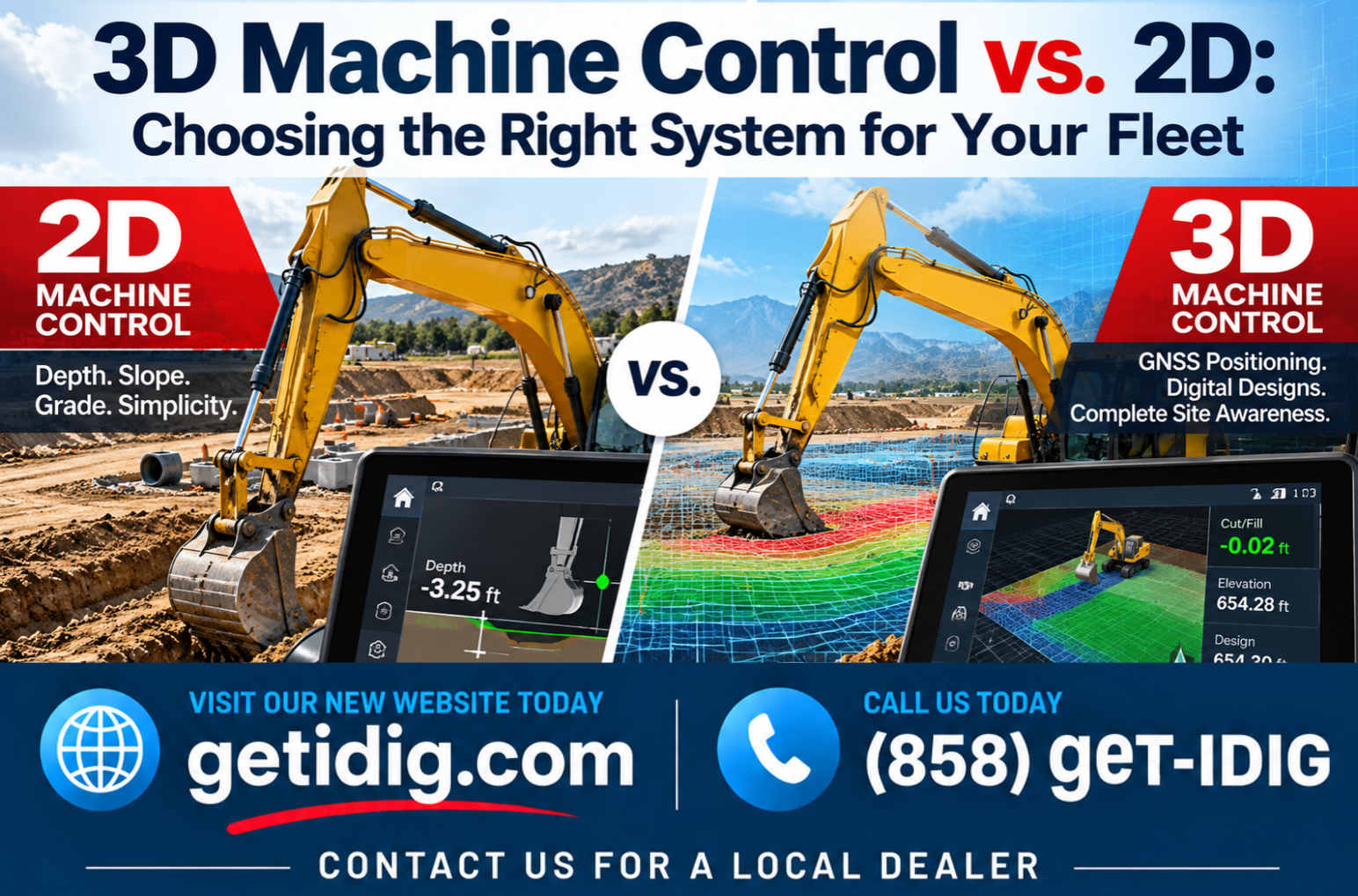
2D and 3D machine control can both improve excavation productivity, but they solve different problems. 2D provides straightforward depth, slope, and grade guidance for everyday excavation, while 3D adds GNSS positioning and digital project models for complete site awareness. Understanding the differences can help contractors choose the right technology for each machine, project, and stage of fleet growth.
Share this article
Found this useful? Share it with your crew, customers, or industry network.
Summary Excerpt
2D and 3D machine control can both improve excavation productivity, but they solve different problems. 2D provides straightforward depth, slope, and grade guidance for everyday excavation, while 3D adds GNSS positioning and digital project models for complete site awareness. Understanding the differences can help contractors choose the right technology for each machine, project, and stage of fleet growth.
Body
3D Machine Control vs. 2D: Choosing the Right System for Your Fleet
Machine control has moved from being specialized technology used primarily on major infrastructure projects to a practical productivity tool for excavation contractors of virtually every size. But as contractors begin evaluating machine control, one question comes up repeatedly:
Should we invest in 2D or 3D?
The answer depends less on which technology is more advanced and more on what you actually need your machines to accomplish.
2D machine control can provide tremendous value for contractors who need reliable depth, slope, and grade information without the complexity of a full digital site model. 3D machine control takes that capability further by adding precise GNSS positioning and digital designs, allowing the machine to understand where it is on the project and what the finished surface should be at that exact location.
Both technologies can reduce grade checking, improve operator efficiency, and help contractors work more accurately.
The key is putting the right technology on the right machine.
What Is 2D Machine Control?
2D machine control provides the operator with continuous information about the position of the bucket or attachment relative to a defined reference.
On an excavator, sensors monitor the movement and position of the machine's working components. Once the operator establishes a reference and enters the desired depth or slope, the system continuously calculates the bucket's position.
The operator can see that information directly on the in-cab display.
Instead of digging, stopping, getting out of the machine, checking grade, returning to the cab, and repeating the process, the operator has continuous guidance while working.
For many excavation applications, that is exactly what is needed.
Where 2D Excels
2D machine control is particularly effective when the primary questions are:
How deep am I?
What is my slope?
How far am I from finished grade?
That makes 2D well suited for applications including:
- Utility trenching
- Drainage
- Foundations and footings
- Basement excavation
- Septic systems
- Ditches
- Simple slopes
- Building pads
- General excavation
- Repetitive depth work
For contractors performing these types of projects every day, 2D can deliver meaningful productivity improvements without requiring a complete 3D digital construction workflow.
The Simplicity Advantage of 2D
One of 2D machine control's greatest strengths is simplicity.
The contractor can gain real-time machine guidance without necessarily requiring GNSS receivers, RTK corrections, cellular connectivity, digital project models, or additional positioning infrastructure.
That can translate into a lower barrier to entry and a system operators can begin incorporating into their normal workflow quickly.
For a contractor primarily interested in reducing manual grade checks and helping operators maintain depth and slope, adding unnecessary complexity may not provide additional value.
Sometimes the simpler system is the better system.
What Changes With 3D Machine Control?
3D machine control adds another critical element:
Position.
A 2D system understands the geometry of the machine and its relationship to a reference. A 3D system can additionally determine where the machine is located on the project.
Using GNSS positioning—typically with high-accuracy correction technology such as RTK—the machine can establish its position and compare it with a digital project model.
That means the operator does not simply know the bucket's depth.
The system can determine what the design elevation should be at the machine's current location.
That is the fundamental advantage of 3D.
Digital Designs Change the Equation
Consider a project where the required elevation changes continuously across the site.
With 2D, the operator may need to establish different references as the machine moves into different areas.
With 3D, the changing elevations can already exist within the digital model.
The machine knows where it is.
The model knows what should be built there.
The machine-control system brings those two pieces of information together.
The operator can then receive real-time cut-and-fill information based on the actual project design.
For complex earthmoving projects, that capability can dramatically change the workflow.
Where 3D Makes the Most Sense
3D machine control becomes increasingly valuable as projects become larger or more complex.
Applications can include:
- Commercial site development
- Road construction
- Large building pads
- Subdivisions
- Infrastructure projects
- Complex grading
- Large-scale drainage
- Retention and detention areas
- Projects with changing elevations
- Projects built from digital terrain models
On these projects, the ability to move throughout the site while maintaining a connection to the digital design can reduce repeated reference setup and dependence on traditional staking.
2D vs. 3D Is Really About Information
The difference can be summarized simply:
2D Machine Control
Depth.
Slope.
Grade.
Simplicity.
3D Machine Control
GNSS positioning.
Digital designs.
Cut-and-fill information.
Complete site awareness.
Neither list automatically makes one system better than the other.
The question is which information your operator actually needs to perform the work efficiently.
Consider the Projects You Perform Most Often
Before purchasing machine control, look at your previous year of work.
What did your machines actually spend their time doing?
If the majority of your excavation involves utilities, drainage, foundations, trenches, and straightforward elevation work, a 2D system may provide an excellent return.
If your machines regularly work across large sites with continuously changing design elevations, 3D may eliminate considerably more manual setup and grade information transfer.
Buying technology based on the work you hope to perform someday can lead to unnecessary cost.
Start by evaluating the work generating revenue today.
Consider How Often Your Machines Change Jobs
Fleet utilization matters.
Some machines remain on large projects for months. Others move between small jobs several times per week.
A 3D system may provide tremendous value on a machine working continuously from digital designs.
A machine moving between straightforward residential or utility projects may benefit more from a fast, simple 2D workflow.
The operating environment matters just as much as the technical capabilities.
Consider the Entire Fleet—Not Just One Machine
Contractors should also avoid assuming every machine requires the same configuration.
Your fleet may have several different technology needs.
One excavator could require 3D because it performs the majority of your complex site work.
Another excavator may only need 2D because it spends most of its time installing utilities.
A compact track loader may have another role entirely.
The objective should not necessarily be to standardize every machine at the highest possible technology level.
The objective is to maximize the productivity of the fleet as a whole.
Portability Can Change the Economics
Another important consideration is whether components can move between machines.
If a machine-control system allows certain components to be transferred among compatible machines, the contractor may not need to purchase a complete independent system for every piece of equipment.
That can significantly improve return on investment.
Ask your dealer which components remain permanently installed, which can be transferred, how machines are calibrated, and what is required to move the system from one machine to another.
For contractors with multiple machines but changing utilization requirements, portability can be a major advantage.
Think About the Operator
Machine control only creates value when operators actually use it.
A highly sophisticated system that operators avoid because it is unnecessarily complicated is not an effective investment.
Consider the experience of your operators and the work they perform.
2D can provide an intuitive introduction to machine guidance because the information directly relates to concepts operators already understand: depth, slope, and grade.
3D introduces additional capabilities and workflows, including digital models and positioning.
Neither should be intimidating when properly installed and supported, but training remains essential.
What About GNSS and RTK?
For most 3D machine-control applications, precise positioning is essential.
Standard satellite navigation does not normally provide the accuracy required for precision excavation.
That is why 3D systems commonly use RTK—Real-Time Kinematic—GNSS corrections.
RTK can provide centimeter-level positioning under appropriate conditions, allowing the machine-control system to determine the machine's location with the precision necessary to compare it with the digital project design.
Depending on the system and location, corrections may come from a local base station or a compatible correction network.
These requirements should be considered when comparing the total investment in 2D and 3D.
Compare Total Cost of Ownership
Do not compare systems using hardware price alone.
Evaluate the complete cost.
Depending on the configuration, that may include:
- Machine hardware
- Sensors
- Displays
- GNSS receivers
- Installation
- Machine calibration
- RTK correction services
- Cellular connectivity
- Digital model preparation
- Software
- Training
- Support
- Additional machine kits
- Future upgrades
The cheapest purchase price does not necessarily produce the lowest operating cost.
Likewise, a more expensive 3D system may quickly justify its additional investment when deployed on projects where its capabilities eliminate significant staking, grade checking, rework, or lost production.
Can You Begin With 2D and Upgrade Later?
This should be one of the first questions contractors ask when comparing systems.
You may not need 3D today.
That does not mean you will not need it in the future.
If your company is growing into larger site-development projects, look for a machine-control platform that provides a logical upgrade path.
Ask whether existing displays, sensors, and other hardware can remain in place if you move from 2D to 3D.
A modular approach can allow contractors to invest based on today's requirements while preserving the ability to expand tomorrow.
You May Need Both
For many contractors, the best answer is not 2D or 3D.
It is 2D and 3D.
A mixed fleet can use different levels of machine control based on each machine's role.
A utility excavator may operate extremely efficiently with 2D guidance.
A production excavator performing complex earthmoving may benefit from 3D.
Another machine may not require machine control at all.
That is a fleet strategy rather than a product strategy.
And it can produce a better return than simply equipping every machine identically.
Questions to Ask Before Making the Decision
Before choosing between 2D and 3D, discuss these questions with your machine-control dealer:
- What type of excavation represents most of our work?
- How often do our projects use digital models?
- How much time do we currently spend checking grade?
- How much traditional staking do our projects require?
- Which machines would benefit most?
- Can components move between machines?
- What is required to upgrade from 2D to 3D?
- What GNSS or RTK services are required?
- Are there recurring subscription costs?
- Who prepares the digital models?
- What operator training is included?
- Who provides technical support?
- What does installation involve?
- What happens as we add additional machines?
A knowledgeable dealer should be able to discuss these questions based on your fleet and applications rather than simply recommending the most expensive configuration.
The Bottom Line
2D and 3D machine control are both powerful construction technologies, but their value depends on how they are applied.
Choose 2D when your operators primarily need reliable depth, slope, and grade guidance with a straightforward workflow.
Choose 3D when your projects require precise machine positioning, digital designs, changing elevations, and broader site awareness.
And when your fleet performs both types of work, consider using both technologies where each makes the most operational and financial sense.
The goal is not to put the most technology possible on every machine.
The goal is to give every machine exactly the technology it needs to perform its job more efficiently.