
How 2D Machine Control Reduces Grade Errors on Excavation Projects
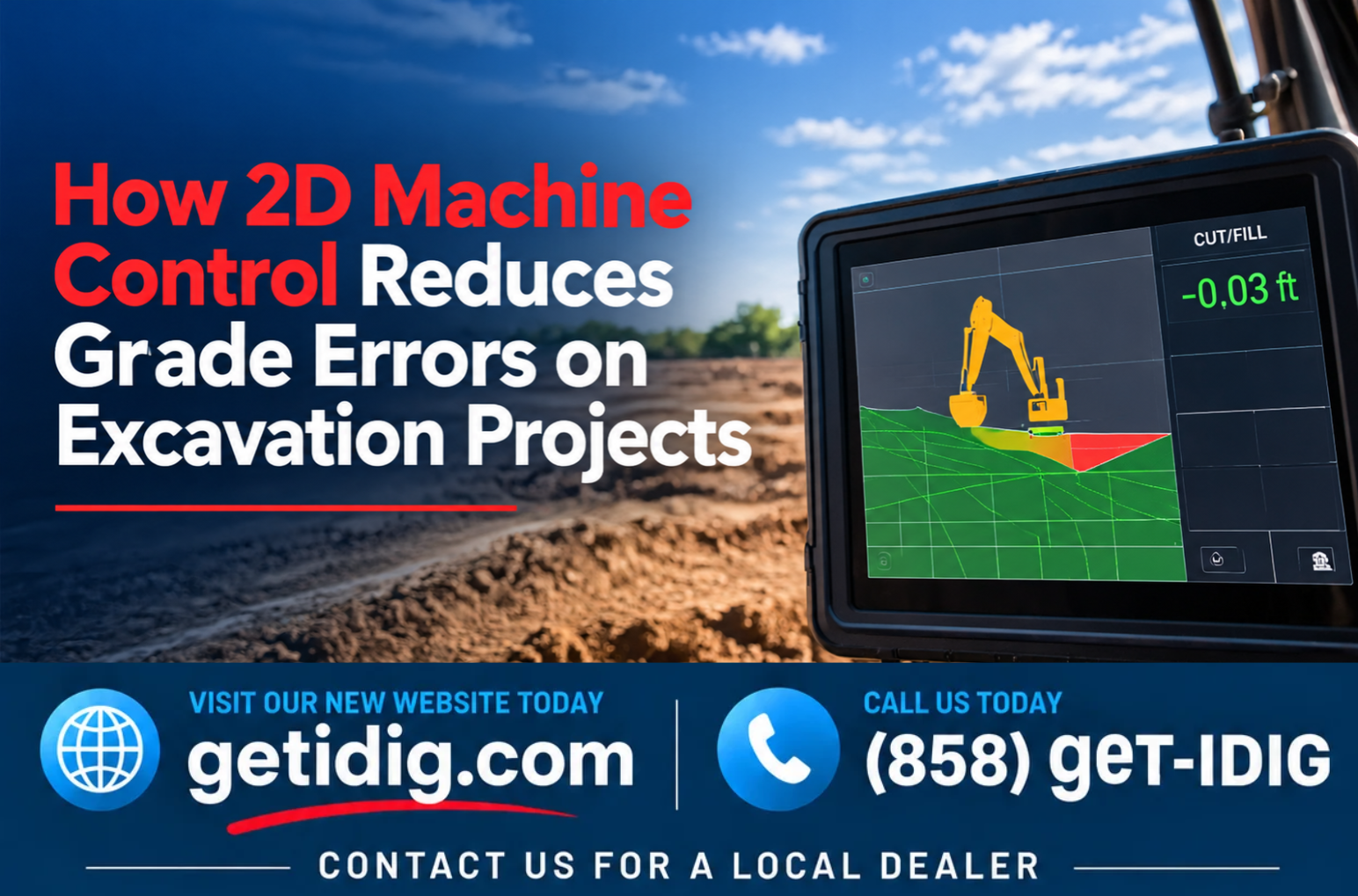
Grade errors can quickly turn into over-excavation, additional material, unnecessary machine time, repeated grade checks, and costly rework. 2D machine control gives operators real-time depth, slope, and elevation guidance directly inside the cab, helping them understand where the bucket is relative to the target grade while they work. By providing continuous grade information, contractors can excavate more consistently, reduce dependence on manual checking, and reach finished grade with fewer corrections.
Share this article
Found this useful? Share it with your crew, customers, or industry network.
Summary
Grade errors can quickly turn into over-excavation, additional material, unnecessary machine time, repeated grade checks, and costly rework. 2D machine control gives operators real-time depth, slope, and elevation guidance directly inside the cab, helping them understand where the bucket is relative to the target grade while they work. By providing continuous grade information, contractors can excavate more consistently, reduce dependence on manual checking, and reach finished grade with fewer corrections.
Body
How 2D Machine Control Reduces Grade Errors on Excavation Projects
Excavation has always depended on accuracy. Dig too deep and material may need to be replaced. Stop too high and the area needs another pass. Miss the required slope and drainage, utilities, foundations, or subsequent construction can be affected.
Traditional excavation methods often require the operator to rely on stakes, grade rods, lasers, stringlines, or another person checking elevation outside the machine. Those methods can work, but they introduce interruptions and opportunities for error.
2D machine control changes that workflow by bringing grade information directly into the cab.
Giving the Operator Grade Information in Real Time
The fundamental advantage of 2D machine control is straightforward: the operator can see the position of the bucket relative to the desired depth, elevation, or slope while excavating.
Instead of digging, stopping, checking grade, making an adjustment, and checking again, the operator receives continuous guidance.
That doesn't eliminate the operator's role. It gives the operator better information for making each cut.
The result can be a more controlled excavation process with fewer unnecessary corrections.
Reducing Over-Excavation
Over-excavation is one of the most common and expensive grade errors.
Removing several additional inches of material may not sound significant, but across a trench, foundation, building pad, or larger excavation, those inches can represent substantial additional volume.
Once material has been removed unnecessarily, the contractor may need to replace it with approved material and compact it properly.
That means the original error can create several additional operations:
- Additional excavation
- Additional trucking or material handling
- Replacement material
- Compaction
- Labor
- Machine time
- Additional grade verification
2D machine control helps the operator see when the bucket is approaching the target, reducing the likelihood of continuing below the required grade.
Reducing Under-Excavation
Stopping short of grade creates a different problem.
The machine may need to return to an area that appeared complete and remove additional material.
That means another pass, additional machine movement, and potentially another grade check.
With continuous depth information available inside the cab, the operator can work toward the target more deliberately instead of relying primarily on visual judgment.
Maintaining Consistent Slopes
Excavation isn't always about reaching a single elevation.
Many projects require a specific slope.
Drainage work, ditching, road construction, site development, landscaping, utility work, and numerous other applications depend on maintaining consistent slope over distance.
A small error at one point can become much larger as the excavation continues.
With 2D guidance, the operator can establish a target slope and reference the bucket against that target throughout the excavation.
That makes it easier to maintain consistency from one end of the work area to the other.
Fewer Trips Out of the Cab
Every time an operator stops the machine and exits the cab to check grade, production stops.
The same is true when another employee needs to enter the excavation area to take measurements.
Reducing those interruptions can improve both productivity and workflow.
With grade information available on the machine-control display, many routine checks can be performed by the operator without leaving the operating position.
Verification may still be required at appropriate points, but the excavation process becomes less dependent on constant manual checking.
Reducing Dependence on Visual Estimation
Experienced operators can develop an impressive ability to judge depth and slope.
But even experienced operators are still working with visual references that can change throughout the project.
Soil conditions, changing light, machine position, site congestion, weather, and the geometry of the excavation can all make visual estimation more difficult.
2D machine control adds an objective reference.
Instead of asking, "Does this look right?" the operator has additional information showing how the bucket relates to the established target.
That combination of operator experience and real-time guidance can produce a more repeatable result.
Helping Less-Experienced Operators
The construction industry continues to face pressure around experienced equipment operators.
Machine control does not replace operator skill, but it can make critical information easier to understand.
A less-experienced operator who can see depth and slope information while working has an additional reference for understanding what the machine is doing.
Over time, that feedback can also help operators develop a better understanding of grade.
For contractors developing newer operators, that can be an important benefit.
Reducing Rework
Grade errors rarely end with the excavation itself.
A mistake can affect the next stage of construction.
If a trench is incorrect, pipe installation may be affected. If a building pad is wrong, subsequent grading or foundation work may require correction. If drainage slopes are inconsistent, water may not move as designed.
Correcting these issues after other work has begun can be considerably more expensive than getting the excavation right initially.
2D machine control helps move grade verification earlier in the process by giving the operator information during excavation rather than discovering every discrepancy afterward.
Better Material Control
Accuracy also affects how much material moves through a project.
Excavating closer to the intended design can reduce unnecessary material removal and replacement.
On projects involving aggregate, bedding material, base material, or imported fill, improved excavation accuracy can help contractors manage quantities more effectively.
The objective isn't simply to dig faster.
It is to move the amount of material the project actually requires.
Improving Trenching Operations
Trenching is particularly well suited to 2D machine control.
A trench may need to maintain a specific depth or slope across a substantial distance. Traditional workflows can require repeated measurements as excavation progresses.
With 2D guidance, the operator can monitor the excavation continuously.
This can be useful for applications such as:
- Water lines
- Sewer lines
- Storm drainage
- Electrical utilities
- Communications infrastructure
- Footings
- Drainage systems
The ability to maintain a consistent reference throughout the trench can reduce corrections later in the process.
Foundation and Footing Excavation
Foundation excavation requires accuracy because subsequent construction depends on the dimensions and elevations created by the excavator.
Over-excavating can require additional material and preparation. Under-excavating can delay the next crew while corrections are made.
2D machine control provides the operator with another tool for approaching target elevation accurately and consistently.
That can help create a cleaner handoff between excavation and the next construction phase.
Less Reliance on Stakes
Stakes remain an important part of many construction workflows, but relying on them as the operator's primary source of grade information can create limitations.
Stakes can be damaged, moved, buried, or become difficult to see from the machine.
Machine control allows more of the working reference to exist digitally inside the cab.
That doesn't necessarily eliminate all staking or survey verification. It reduces how dependent the operator is on constantly seeing and interpreting external references.
Accuracy Can Improve Productivity
Accuracy and productivity are closely connected.
A machine moving quickly but repeatedly correcting mistakes isn't necessarily productive.
True productivity comes from completing the required work correctly with as little unnecessary movement, checking, and rework as possible.
When operators have better grade information, they can make more deliberate cuts.
That can mean fewer passes, fewer corrections, and less time spent determining whether the excavation has reached the target.
2D Doesn't Require a Full 3D Workflow
Not every contractor needs a complete 3D machine-control environment.
Many excavation projects primarily require accurate depth and slope information.
For those applications, 2D machine control can provide substantial benefits without requiring GNSS positioning or a digital 3D project model.
That makes 2D an accessible entry point for contractors who want to improve excavation accuracy while maintaining a relatively straightforward workflow.
One System Can Serve Multiple Applications
The value of 2D machine control isn't limited to one specific type of project.
Contractors can use the same fundamental technology across a variety of excavation tasks, including trenching, foundations, drainage, site preparation, grading, utility installation, and general earthmoving.
For contractors performing different types of work throughout the year, that flexibility can increase the value of the investment.
The Operator Is Still in Control
Machine control should not be confused with fully autonomous excavation.
With a 2D guidance system, the operator still controls the machine.
The technology provides information.
The operator uses that information, along with experience and knowledge of the project, to make better decisions.
That distinction is important because the objective isn't to remove the operator from the process.
It's to give the operator a more accurate reference while working.
Small Errors Become Expensive at Scale
A grade error of an inch or two may appear insignificant when looking at a single bucket of material.
Across hundreds of feet of trench, a large building pad, or repeated excavation operations, those small differences can accumulate.
The same applies to time.
A few minutes spent checking and correcting grade may not appear significant once. Repeated dozens of times throughout a day, those interruptions become hours of lost production.
Machine control addresses both sides of that equation: accuracy and consistency.
The Bottom Line
2D machine control helps reduce grade errors by putting depth, slope, and grade information where the operator needs it most—inside the cab and available during excavation.
The technology does not eliminate the need for skilled operators, project verification, or sound construction practices. Instead, it provides operators with better information for making each cut.
For contractors, that can mean less over-excavation, fewer corrections, reduced manual grade checking, better material control, more consistent slopes, and less rework.
Ultimately, the value of 2D machine control isn't simply knowing where the bucket is.
It's knowing where the bucket is before a grade error becomes an expensive problem.